At Charm Dental Care, we believe knowing your teeth numbers and names is empowering. With 32 permanent teeth, each named and numbered, your dentist can communicate clearly and plan care accurately. The Universal system, where each tooth is assigned a number from 1 to 32, ensures you always know which tooth is being discussed.
Our goal is to help you feel involved and informed during your dental visits. At Charm Dental Care, we guide patients through dental anatomy to help them better understand their oral health and make informed decisions about their care.
In this blog, we’ll explore how tooth numbering works, what each tooth does, and why it matters for your smile.
Table of Contents

Key Takeaways
- Adult teeth are numbered from 1 to 32 using the Universal Numbering System.
- Tooth #1 starts at the upper right wisdom tooth and ends with #32 at the lower right wisdom tooth.
- Teeth are categorized into incisors, canines, premolars, and molars.
- Incisors (front teeth) help cut food.
- Canines are sharp teeth used for tearing food.
- Premolars help with chewing and breaking down food.
- Molars are used for grinding food.
- Wisdom teeth are usually numbered as 1, 16, 17, and 32.
- Understanding tooth numbers helps patients follow dental treatments better.
Why Dental Anatomy Knowledge Matters for Patients?
Understanding the basic structure of your teeth isn’t just for dentists it’s valuable for you as a patient. Whether you’re reviewing an X-ray, discussing treatment options, or planning a dental procedure, having a general understanding of tooth numbers and names helps you:
- Ask informed questions
- Understand your treatment plan
- Track oral health over time
- Feel more confident and involved in your care
When your dentist refers to “tooth 19” or suggests extracting “tooth 1,” it’s much easier to follow along when you know where that tooth is and what function it serves.
A Quick Overview of Dental Arches and Quadrants
The mouth is divided into two dental arches: the upper arch (maxillary) and the lower arch (mandibular). Each arch is further divided into two quadrants:
- Upper Right (Teeth 1–8)
- Upper Left (Teeth 9–16)
- Lower Left (Teeth 17–24)
- Lower Right (Teeth 25–32)
Each quadrant contains a similar set of tooth types: incisors, canines, premolars, and molars. This symmetrical structure plays a key role in proper chewing, speaking, and maintaining jaw alignment.
Tooth Numbering System Dentists Use
Dentists use a tooth number chart to clearly identify each tooth in your mouth. This helps avoid confusion during exams, treatments, and dental records.
The most common method in the U.S. is the Universal Numbering System. In this system, adult teeth are numbered from 1 to 32. Tooth number 1 starts at the upper right third molar, and the count moves across the upper teeth to the upper left third molar (tooth 16).
It then continues with tooth 17 on the lower left and ends at tooth 32 on the lower right.
Other systems include the Palmer Notation System, which utilizes symbols and numbers to represent each quadrant, and the FDI system, which employs two-digit codes to denote tooth location.
To make this easier to understand, a visual tooth number chart showing both front and side views is often used in dental offices.
Read More: What Is Considered a Dental Emergency?

Teeth Names and Functions
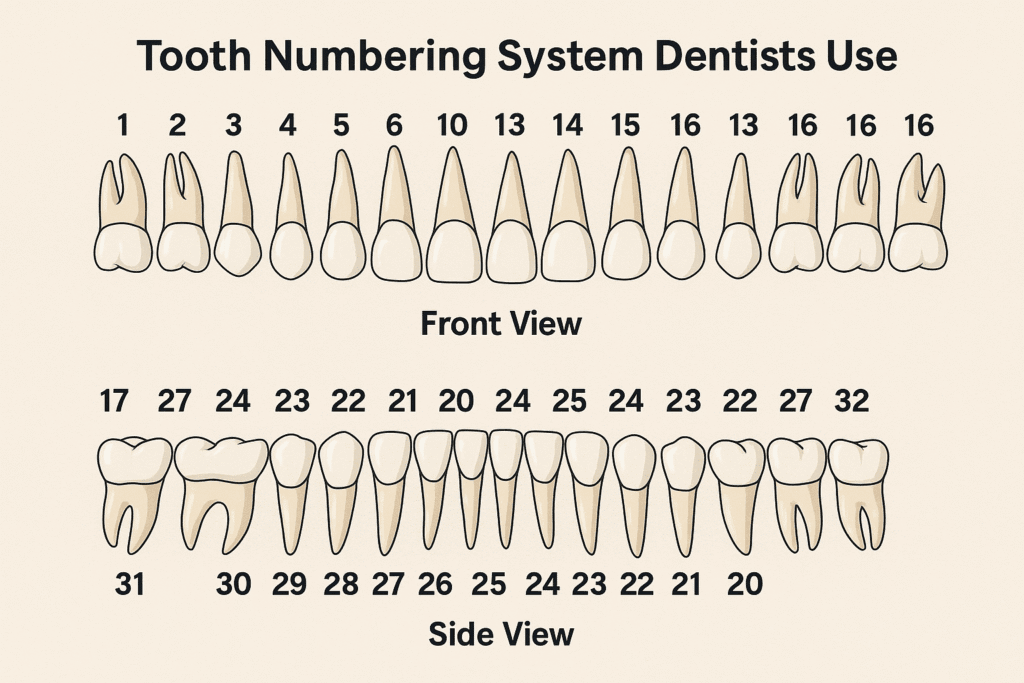
Dentists use a tooth chart with numbers to identify and explain the purpose of each tooth. Every tooth has a role in helping you chew, speak, and smile with confidence.
- Incisors (Teeth 7–10): Flat-edged front teeth used for cutting food.
- Canines (Teeth 6, 11, 22, 27): Pointed teeth designed to tear food.
- Premolars (Teeth 4–5, 12–13, 20–21, 28–29): Help with crushing and grinding.
- Molars (Teeth 1–3, 14–16, 17–19, 30–32): Strong back teeth used for chewing.
- Wisdom Teeth (Teeth 1, 16, 17, 32): The last molars are often removed due to crowding.
A detailed teeth chart with numbers helps patients understand where each tooth is located and what it does. Internal links to wisdom teeth removal or tooth extraction services can be added here if needed.
Adult Tooth Chart by Number
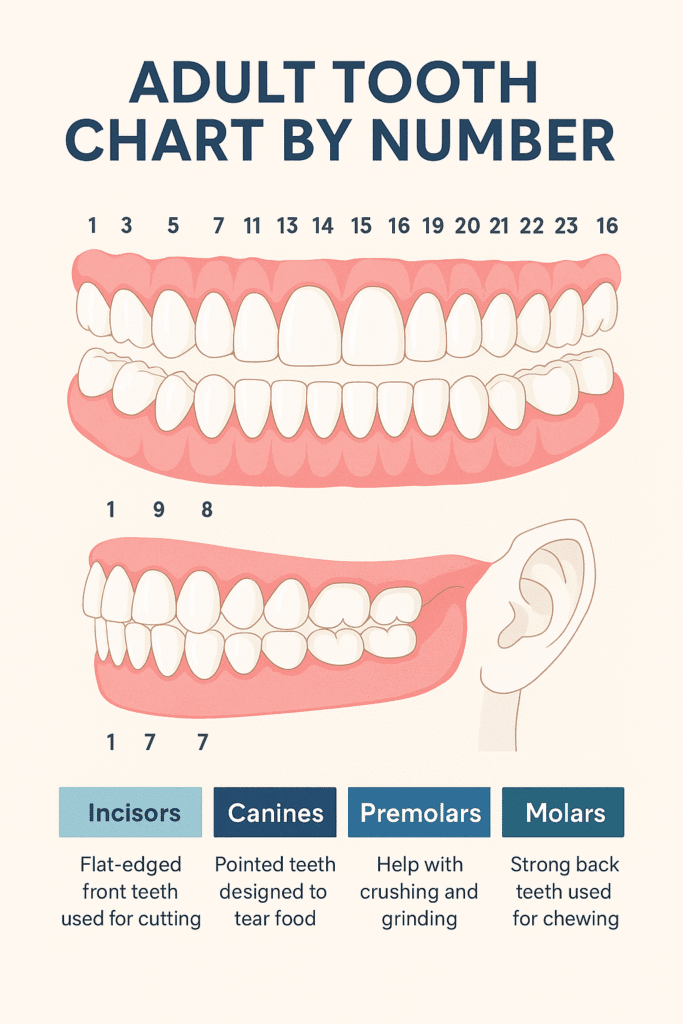
An adult tooth chart is a helpful tool that shows the position, name, and function of all 32 permanent teeth. Dentists use it to explain treatments and track oral health with accuracy. The chart is typically divided into two arches:
- The upper arch (maxillary) includes teeth numbered 1 to 16.
- The lower arch (mandibular) includes teeth numbered 17 to 32.
Each tooth is assigned a specific number and has a distinct role, such as cutting, tearing, or grinding food. These charts also highlight the symmetry of your smile, showing how teeth are mirrored on both sides of the mouth.
By using an adult tooth chart with front and side views, patients can better understand their dental anatomy and feel more confident during appointments.
Read More: Oral Sedation Basics: What You Need to Know About Sedation Dentistry in Richmond

Why Understanding Tooth Numbers Matters?
Being familiar with tooth numbers has several advantages:
- Improved Communication: You’ll know exactly which tooth is being discussed.
- Better Decision-Making: Understand your options when it comes to extractions, fillings, or root canals.
- Confidence in Care: You’ll feel more informed and less anxious during procedures.
At Charm Dental Care, we take the time to walk you through your dental anatomy so you never feel left in the dark about your oral health.
Common Dental Treatments by Tooth Type
Knowing your tooth types also helps you understand why you’re receiving a specific treatment:
| Tooth Type | Common Treatments |
|---|---|
| Incisors | Fillings, crowns, root canals, and extraction |
| Canines | Fillings, root canal, crown placement |
| Premolars | Fillings, crowns, orthodontics |
| Molars | Fillings, crowns, root canals, extraction |
| Wisdom Teeth | Extraction due to impaction or decay |
Dental Expertise at Charm Dental Care
Charm Dental Care – Richmond, TX
If you’re located in Richmond, TX, our dental team offers comprehensive services including routine cleanings, wisdom tooth extractions, sedation dentistry, and more. We’ll guide you through your dental chart and treatment plan so you feel confident and comfortable.
Schedule your visit today with our Richmond office for expert, patient-focused dental care.
Charm Dental Care – Katy, TX
At our Katy, TX location, we blend advanced dental technology with clear, personalized education. Whether you’re reviewing a tooth chart, exploring orthodontic options, or planning a filling, we make every step easy to understand.
Please book an appointment at our Katy office and experience care built around clarity and comfort.
Charm Dental Care – Humble, TX
In Humble, TX, our clinic is committed to helping patients make informed decisions about their dental care. From simple check-ups to complex treatments, our team guides you through each procedure using detailed charts and clear, plain language.
Visit our Humble location to take the guesswork out of your dental care.
Charm Dental Care – Spring, TX
Our Spring, TX office is trusted for gentle, transparent dental care. Whether you’re considering wisdom tooth removal, need help reading your dental chart, or want options for sedation dentistry, we’re here for you.
Schedule a visit to our Spring office for supportive, educational dental care.
You Might Also Like
- How to Prepare for Root Canal Treatment
- What Can Be Done During a Dental Emergency?
- Top Ways to Prevent Cavities in Children
Conclusion
Understanding your teeth and how they’re numbered can make every dental visit more meaningful. A basic knowledge of dental anatomy helps you communicate clearly and feel confident about your treatment. At Charm Dental Care, we proudly guide patients through their oral health journey, whether you’re visiting us in Spring, Katy, Richmond, or Humble, TX. If you’d like to learn more about your dental anatomy in Spring, TX, or need help reading your tooth chart, we’re here for you. Feel free to contact us today to schedule an appointment and take the next step toward informed comfortable dental care.
Frequently Asked Questions (FAQ)
-
What is tooth number 13?
Tooth 13 is the upper left second premolar. It helps with chewing and maintaining a balanced bite.
-
What tooth is number 29 used for?
Tooth 29 is a lower right second premolar that’s used for grinding food during chewing.
-
Which teeth are wisdom teeth?
Wisdom teeth are numbers 1, 16, 17, and 32 — located at the very back of the mouth.
-
How are molars numbered in adults?
Molars are numbered 1–3, 14–16, 17–19, and 30–32. They are your strongest chewing teeth.
-
What do dentists mean by tooth 19?
Tooth 19 is the lower left first molar. It plays a big role in chewing and jaw alignment.
-
How many teeth are in the adult human mouth?
There are 32 permanent teeth in adults, including four wisdom teeth at the back.
-
How do dentists number your teeth?
Dentists use a tooth number chart that labels each tooth from 1 to 32 in a set order.
-
What number is a canine tooth?
Canines are numbered 6, 11, 22, and 27. They’re sharp and help tear food.
-
Can a dentist identify a tooth by its number?
Yes, at Charm Dental Care, we use the dental numbering chart to identify each tooth quickly and clearly.
-
What’s the difference between upper and lower tooth numbers?
Upper teeth are numbered 1–16 and lower teeth 17–32, starting from the right side and progressing across.
-
Can I get my wisdom teeth removed in Spring, TX?
Absolutely. Charm Dental Care Spring offers gentle wisdom tooth removal. Contact us to book your visit.
-
Where can I ask about my tooth chart in Richmond, TX?
Visit Charm Dental Care Richmond for a full explanation of your tooth numbers. You can also contact us online.